
How Simulation Validated Next-Gen AGV Fleets for Extreme Metals Manufacturing
By validating the entire autonomous robotics framework within AlsanX's simulation ecosystem, the client successfully decoupled technological risk from capital expenditure.
The Problem: Hostile Frontiers and Capital Risks for Automation in Metals Manufacturing
Heavy industrial environments like steel mills and aluminum smelting facilities represent some of the most hostile frontiers for automation. Standard automated guided vehicles (AGVs) and autonomous mobile robots routinely fail when subjected to the extreme heat, dense airborne particulate dust, massive structural loads, and severe electromagnetic interference (EMI) characteristic of metals manufacturing. Operations directors face a paralyzing dilemma: continue relying on manual labor in high-risk zones, or risk millions in capital expenditure on unproven autonomous robotics that might fail under real-world stresses.
Furthermore, blind adjustments to logistics workflows carry massive operational risks. If an autonomous fleet experiences sensor drift from LiDAR or visual SLAM (vSLAM) dropouts in a live facility, it causes catastrophic bottlenecks or severe safety incidents. Traditional engineering intuition and static spreadsheets completely fail to model the dynamic, chaotic variables of a harsh production floor, leaving plant leadership without a reliable mechanism to justify the ROI of advanced robotic integration.
Images & Video
Challenges · Solution · Results
- Extreme heat, dense airborne particulate dust, massive structural loads, and severe electromagnetic interference (EMI) cause standard AGVs to fail.
- High operational risks from sensor drift (LiDAR) or visual SLAM (vSLAM) dropouts causing bottlenecks or safety incidents.
- Traditional engineering intuition and static spreadsheets completely fail to model dynamic, chaotic variables of a harsh production floor.
- High capital risks when purchasing unproven autonomous robotics for extreme environments.
- Built an advanced digital twin and dynamic simulation framework using AlsanX EBI Twin+ and EBI SIM.
- Simulated precise performance of LiDAR, vSLAM, and obstacle detection algorithms under heavily degraded dust and EMI conditions.
- Stress-tested low-latency 5G teleoperation to map network latency thresholds for remote operator takeover.
- Implemented vendor-agnostic VDA 5050 interfaces integrated with simulated ERP and WMS to evaluate multi-robot fleet coordination.
- Decoupled technological risk from capital expenditure with zero capital risk exposed during validation.
- 100% elimination of human worker exposure in high-risk, extreme-heat zones by establishing a remote teleoperation model.
- Verified 24/7 operational capability for multi-robot fleets using VDA 5050 coordination.
- Prevented capital misallocation and eliminated scalability bottlenecks before physical equipment procurement.
In-Depth Documentation
What AlsanX Did
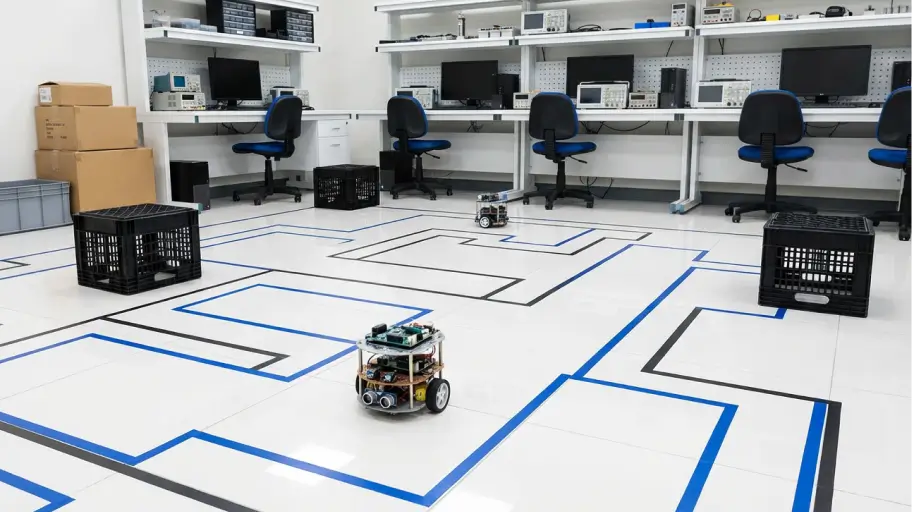
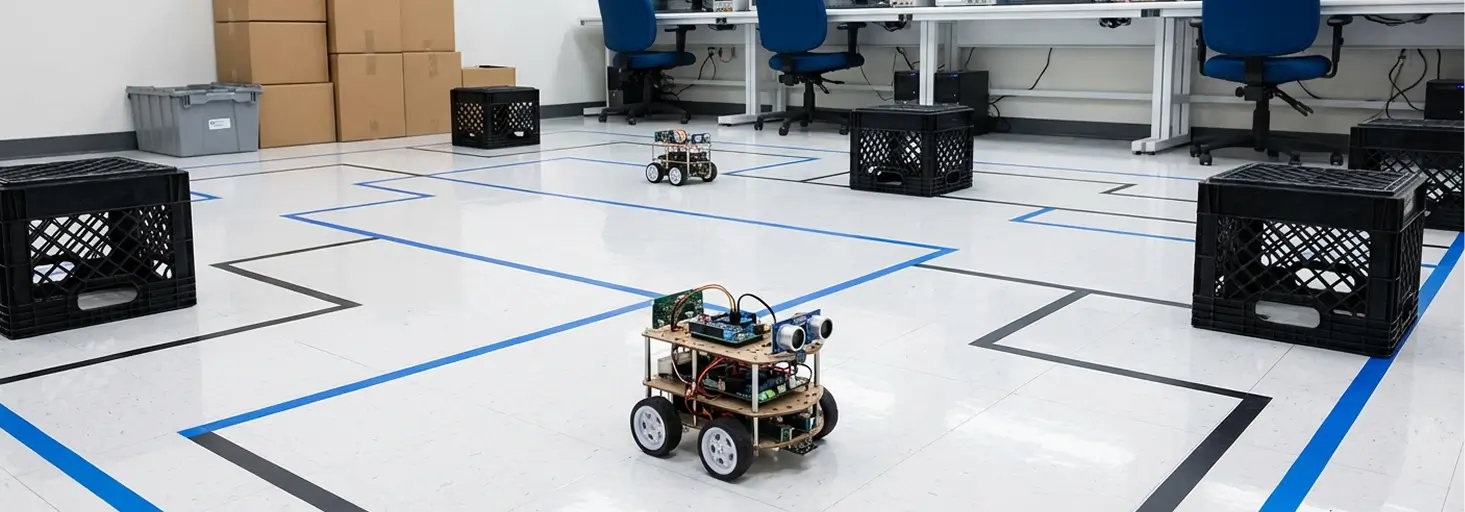
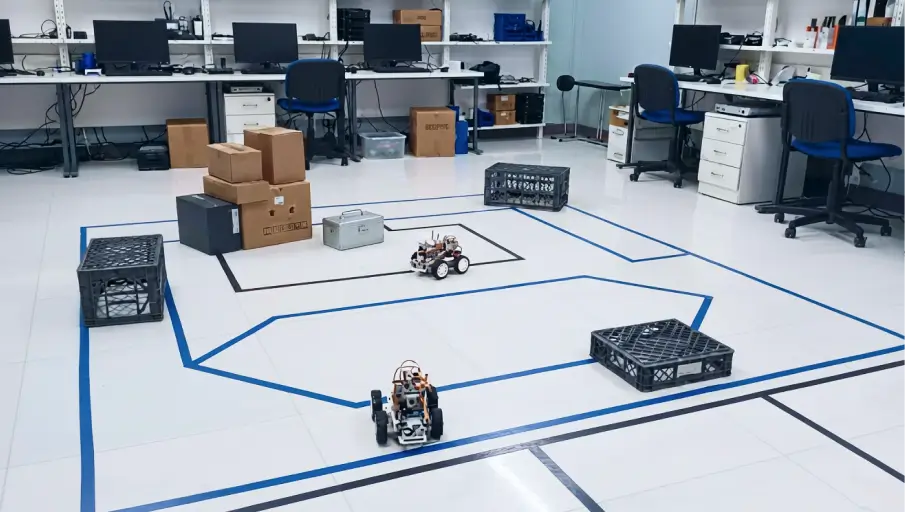
AlsanX addressed this challenge by building an advanced digital twin and dynamic simulation framework using AlsanX EBI Twin+ and EBI SIM. Instead of relying on rigid, static assumptions, the simulation captured real-world operating patterns, complex spatial geometry, and environmental hazards. By modeling small-scale physical demonstrators alongside high-fidelity virtual environments, AlsanX simulated the precise performance of LiDAR, vSLAM, and real-time obstacle detection algorithms inside an environment heavily degraded by simulated dust and EMI.
To handle edge cases where absolute autonomy fails, the simulation evaluated a hybrid operational model. AlsanX stress-tested low-latency 5G teleoperation, mapping network latency thresholds to determine exactly how a remote operator could safely seize manual control of an AGV near hot-metal zones. Finally, the simulation evaluated multi-robot fleet coordination by implementing vendor-agnostic VDA 5050 interfaces integrated directly with simulated Enterprise Resource Planning (ERP) and Warehouse Management Systems (WMS), making hidden routing constraints and deadlocks visible before physical procurement.
The Outcome
By validating the entire autonomous robotics framework within AlsanX’s simulation ecosystem, the client successfully decoupled technological risk from capital expenditure. The dynamic analysis proved the viability of multi-robot logistics under extreme conditions and established an ironclad operational design that guarantees worker safety and zero production downtime. The company now possesses a clear, data-driven roadmap to scale its autonomous fleet, having eliminated the threat of multi-million dollar integration errors before a single piece of heavy equipment was ordered.
Technical Friction Quantified
- LiDAR and vSLAM Degradation: Modeled sensor attenuation from heavy industrial dust, establishing reliable sensor redundancy baselines.
- 5G Teleoperation Latency: Validated safe remote-control boundaries under simulated low-latency 5G networks to ensure immediate operator takeover in emergencies.
- VDA 5050 Interoperability: Identified and resolved protocol deadlocks between heterogeneous robotic fleets during high-throughput logistics cycles.
Strategic Risks Extinguished
- Capital Misallocation Prevented: Eliminated the risk of purchasing expensive robotic platforms that cannot withstand the facility’s EMI and thermal profile.
- Hazardous Exposure Eliminated: Removed manual operators from high-risk, extreme-heat production zones by shifting operations to a remote teleoperation model.
- Scalability Bottlenecks Removed: Ensured seamless integration with core ERP/WMS systems, smoothing out material flow variations prior to full-scale deployment.
Tools & Technologies
Are you ready to deploy autonomous robotics but can't afford the capital risk of a harsh-environment failure?
Request an AlsanX Robotic Feasibility & Bottleneck Audit to validate your automation strategy before you buy.
Get in Touch →Explore more case studies
See how we've applied these methods across logistics, manufacturing, and beyond.
View All Case Studies →