
SmartMix: How Probabilistic AI and Computer Vision Transformed Industrial Concrete Formulation
Modern concrete manufacturing requires balancing high mechanical performance with strict environmental constraints. AlsanX deployed its SmartMix platform to replace slow, manual aggregate analysis with automated 3D computer vision and deployed Gaussian Process regression models to optimize alternative binder formulations, successfully cutting carbon emissions without sacrificing structural integrity.
The Problem: Balancing Multi-Objective Engineering Constraints and Eliminating Material Blind Spots
Industrial concrete production faces an increasingly complex array of multi-objective engineering constraints, demanding simultaneous optimization across structural load capacity, field workability, long-term durability, and stringent environmental compliance. To aggressively mitigate carbon footprints, industrial producers frequently attempt to substitute high-emission Portland cement with Supplementary Cementitious Materials (SCMs) such as fly ash and slag. However, introducing these blended chemistries triggers highly nonlinear, high-dimensional chemical interactions that frequently compromise early-age mechanical strength and field placeability. Because traditional mixture proportioning depends heavily on empirical, resource-intensive physical trial-and-error, operations managers are left navigating a blind design space where a single miscalculation results in catastrophic batch failures or excessive, costly clinker over-design.
Compounding this chemical volatility is a chronic operational bottleneck in physical quality control: aggregate characterization. Coarse and fine aggregates dictate concrete workability and paste requirements, yet conventional mechanical sieve and dimensional caliper testing are notoriously slow and labor-intensive. Traditional sieve analysis relies on small, segmented 5kg samples that frequently suffer from splitting and sampling errors, failing to capture true batch-to-batch material variability. Furthermore, standard tests fail to accurately quantify critical geometric properties like particle circularity, angularity, and surface roughness, forcing engineers to rely on subjective visual scales. This blind spot introduces severe uncertainty into particle packing configurations, leading to unpredictable water demands and erratic concrete performance during field placement.
Images & Video


Challenges · Solution · Results
- Traditional concrete mixture proportioning relies on slow, empirical, resource-intensive physical trial-and-error, leading to a blind design space prone to batch failures or costly clinker over-design.
- Substituting Portland cement with Supplementary Cementitious Materials (SCMs) triggers highly nonlinear, high-dimensional chemical interactions that compromise early-age mechanical strength and field placeability.
- Conventional physical quality control methods like mechanical sieve and dimensional caliper testing are slow, labor-intensive, and prone to sampling and splitting errors.
- Legacy testing fails to accurately quantify critical geometric properties (particle circularity, angularity, and surface roughness), causing erratic water demands and erratic concrete performance during field placement.
- Traditional mechanical sieve testing suffers from significant split-sample variability, causing identical aggregate batches to erroneously register outside acceptable ASTM limits.
- Deployed the AlsanX SmartMix platform, a closed-loop industrial digitalization framework combining edge computer vision with probabilistic machine learning.
- Replaced manual aggregate analysis with a digital profiling routine using standard mobile devices and a universal reference scale to reconstruct precise 3D morphological profiles.
- Applied computer vision models to automatically extract precise gradation data and continuous geometric parameters, including particle circularity, compactness, and surface roughness.
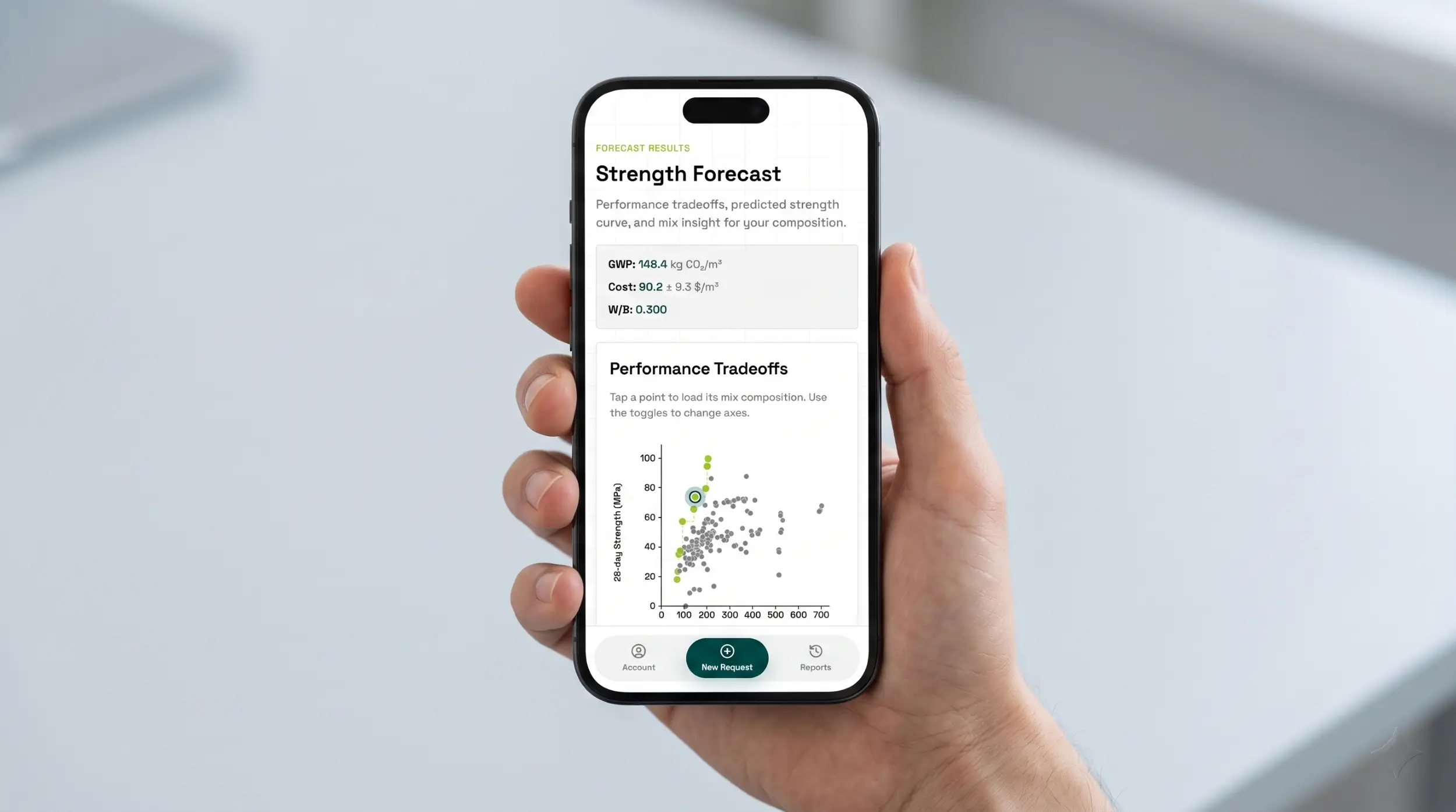
- Integrated aggregate data and volumetric mixture proportions into an advanced probabilistic forecasting model powered by Gaussian Process (GP) regression to track continuous, time-dependent strength-development trajectories.
- Coupled the predictive engine with a Multi-Objective Bayesian Optimization (MOBO) framework utilizing a parallelized Expected Hypervolume Improvement (EHVI) acquisition function to automatically map optimal mix proportions.
- Achieved a 60% reduction in cradle-to-gate Global Warming Potential (GWP) relative to equivalent reference control mixtures.
- Compressed the complete aggregate characterization timeframe from hours down to an automated 3-minute sequence.
- Maintained a 0.94 Coefficient of Determination (R²) in forecasting long-term compressive strength evolution.
- Enabled reliable production of high-performance concrete mixes exceeding 10 ksi compressive strength at 28 days with greater than 50% cement replacement.
- Systematically narrowed predictive 95% confidence intervals from a ±2.4 ksi variance down to an ultra-tight ±0.2 ksi.
- Stripped away the financial and carbon costs of over-designing cement paste, optimizing direct cradle-to-gate GWP down to 150–200 kg CO2e/m³.
In-Depth Documentation
What AlsanX Did
To eliminate these material blind spots and accelerate sustainable mix design, AlsanX developed and deployed SmartMix—a closed-loop industrial digitalization framework that integrates advanced edge computer vision with probabilistic machine learning. The system completely replaces legacy physical sieving with a rapid digital aggregate profiling routine. Plant operators simply distribute an aggregate sample onto a flat surface and capture consecutive images using standard mobile devices alongside a universal reference scale. By executing a series of rapid material agitations, the built-in computer vision model isolates and tracks individual particles across multiple perspectives to reconstruct precise 3D morphological profiles. SmartMix automatically extracts precise gradation data alongside continuous geometric parameters, including particle circularity, compactness, and surface roughness calculated via true particle area comparisons against a calculated convex hull.
Simultaneously, the SmartMix platform ingests this rapid morphological data alongside volumetric mixture proportions into an advanced probabilistic forecasting model powered by Gaussian Process (GP) regression. Rather than relying on rigid, deterministic curves, the GP framework models continuous, time-dependent strength-development trajectories across critical curing ages—specifically 1, 3, 5, 14, and 28 days—while explicitly quantifying epistemic uncertainty. AlsanX coupled this predictive engine with a Multi-Objective Bayesian Optimization (MOBO) framework utilizing a parallelized Expected Hypervolume Improvement (EHVI) acquisition function. This enables powerful inverse mix design; instead of executing weeks of physical lab trials, materials engineers input specified early-age strength thresholds and maximum allowable carbon boundaries, and the algorithm automatically maps the optimal Pareto frontier to recommend precise binder, SCM, and admixture proportions.
The Outcome
The deployment of AlsanX SmartMix successfully transformed the concrete formulation methodology from a reactive, empirical process into an optimized, data-driven digital workflow. By unifying real-time computer vision aggregate tracking with uncertainty-aware Gaussian Process forecasting, the platform achieved the capability to reliably produce high-performance concrete mixes exceeding 10 ksi compressive strength at 28 days while executing greater than 50% cement replacement. This tighter operational quality control compressed the standard deviation of production mixes, driving up the lower-bound strength distribution tail and allowing engineers to safely minimize cement-paste volume without risking structural or field placement failures.
What the SmartMix Platform Uncovered
- Traditional mechanical sieve testing exhibits significant split-sample variability, occasionally causing identical aggregate batches to erroneously register outside acceptable ASTM limits.
- Computer vision particle segmentation remains completely unaffected by aggregate moisture variations or complex surface coloration patterns, establishing its reliability for rugged, on-site wet aggregate imaging.
- High-performance, low-carbon binder spaces exhibit highly non-monotonic strength-to-carbon profiles at 28 days, driven entirely by the delayed latent hydraulic and pozzolanic activation of SCMs.
Operational Risks and Failures Avoided
- Materials engineers eliminated protracted physical trial-and-error cycles by shrinking the aggregate characterization timeframe from hours down to an automated 3-minute sequence.
- Epistemic forecasting error was systematically compressed, narrowing the predictive 95% confidence intervals from a wide ±2.4 ksi variance down to an ultra-tight ±0.2 ksi via progressive, data-diversification learning.
- The financial and carbon costs of over-designing cement paste were stripped away, allowing direct cradle-to-gate Global Warming Potential (GWP) optimization down to 150–200 kg CO2e/m³.
Tools & Technologies
Schedule a Comprehensive SmartMix Bottleneck Audit
Are unpredictable material variations and complex SCM interactions sabotaging your concrete mix optimization?
Get in Touch →Explore more case studies
See how we've applied these methods across logistics, manufacturing, and beyond.
View All Case Studies →